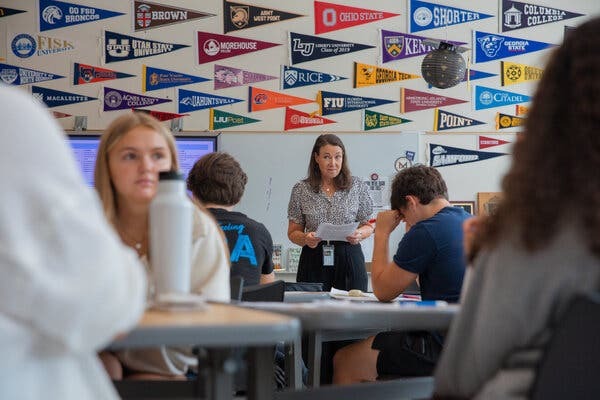

The college admissions essay has long been a sacred space for raw, authentic self-expression, a place where a student’s voice could leap off the page and sway an admissions committee. But that tradition is facing an unprecedented threat. As artificial intelligence tools like ChatGPT infiltrate the application process, universities are grappling with a fundamental question: Can the personal essay survive the age of AI?
The Scale of the Challenge
According to data from the education research group Foundry, approximately one in three college applicants leveraged AI to write part or all of their application essays during the 2023–24 admissions cycle. This surge has ignited fierce debates over academic integrity, authenticity, and the very purpose of the essay requirement. At institutions like Brown University, policies explicitly state that “the use of artificial intelligence by an applicant is not permitted under any circumstances in conjunction with application content”. Yet detection remains an escalating technological arms race.
“AI hasn’t just changed how students write; it’s changing why colleges ask for essays,” notes Dr. Elaine Reeves, an educational ethicist at Stanford. “When authenticity is in doubt, the essay loses its value as a window into the applicant.”
Detection and Deterrence
Admissions offices are deploying sophisticated AI-detection software to identify machine-generated text. Tools like Turnitin now flag linguistic patterns, structural inconsistencies, and stylistic “perfection” atypical of adolescent writers. At the University of North Carolina at Chapel Hill, AI already evaluates essays for “word choice, sentence structure, vocabulary, grammar, and punctuation”. Yet these systems are imperfect. As one admissions director at a top-20 university confided anonymously, “We’re seeing essays that blend AI-generated scaffolding with human anecdotes, a hybrid model that’s notoriously hard to detect”.
The response isn’t purely technological. Some institutions are reducing the essay’s weight in holistic evaluations. Others, like Caltech and Cornell, mandate disclosure statements if AI tools were used in drafting. The Common Application is considering real-time, monitored writing supplements to verify student authorship.

The Institutional Dilemma
Ironically, while policing student use of AI, universities are rapidly adopting it internally. Predictive analytics sorts applications, assesses academic records, and forecasts enrollment likelihood. Georgia Tech’s executive director of enrollment management, Rick Clark, notes AI eliminates “thousands of hours of human time,” freeing staff for personalized review. However, this dual adoption creates tension: Can colleges ethically restrict the tools they deploy?
“The hypocrisy argument resonates with students,” observes college admissions coach Marcus Lee, author of Get Real and Get In. “If universities use AI to scan essays, why can’t students use it to draft them?”.
Beyond Detection: The Equity Question
The crisis isn’t merely about cheating; it’s about opportunity. Prohibitive policies risk penalizing students without access to ethical guidance. “For neurodivergent applicants or those with learning differences, AI can be a lifeline for organizing thoughts,” argues Lee. Conversely, unchecked AI might disadvantage students from under-resourced schools where essay mentoring is scarce.
The Supreme Court’s affirmative action ban has intensified scrutiny of AI’s potential biases. Training data reflecting historical inequalities could skew evaluations. Yet proponents argue that well-audited AI might advance equity by identifying non-traditional strengths obscured by grades. UNC’s system, for example, analyzes essays for writing proficiency without filtering for prestige dialects.
The Road Ahead
Some universities are reimagining the essay entirely. Video submissions, portfolio assessments, and timed writing exercises are gaining traction as AI-resistant alternatives. The University of Chicago now accepts two-minute video profiles, while MIT evaluates project walkthroughs. These shifts prioritize spontaneity and demonstrable skill over polish.
Yet the core challenge remains philosophical. As one Ivy League dean stated, “An essay written by ChatGPT isn’t ‘cheating’ in the traditional sense, it’s a failure of imagination. The essay was never about flawless prose; it was about introducing a human being.”
The Unautomated Self
For now, the essay persists, but its role is evolving. Admissions committees increasingly seek narrative cohesion across applications, where essays, extracurriculars, and recommendations tell a consistent story. “Disjointed applications stand out more than ever,” notes Top Tier Admissions. “If your essay describes a passion for biomedical research, but your activities lack science engagement, AI won’t save you”.
The solution may lie in redefining boundaries. As Clark suggests, AI excels as a “brainstorming assistant,” not a ghostwriter. Institutions like Emory University now offer workshops on ethically using AI for outlining and editing, not drafting.
What emerges from this turbulence isn’t the death of the essay, but its reinvention. In an age of automation, the most radical act might be letting an applicant’s unautomated self speak glitches and all. As Lee concludes, “Admissions officers aren’t looking for AI-perfected candidates; they’re looking for real ones”. The essay’s future may depend on whether technology serves that truth rather than obscuring it.
Subscribe to my whatsapp channel

Comments are closed.