

Cybertruck Sales Crash – 50% Drop Reveals Tesla’s Electric Pickup Struggle
Why Tesla’s Cybertruck Became a Niche Flop: Sales Down 51% in 2025

The much-hyped Tesla Cybertruck has suffered a devastating sales collapse, with second-quarter 2025 deliveries plummeting by approximately 50.8% year-over-year, according to industry analysis. This precipitous decline signals a dramatic fall from grace for Elon Musk’s polarizing electric pickup truck, which was initially touted as revolutionizing the automotive industry but now struggles to find mainstream acceptance amid quality concerns, political backlash, and evaporating consumer enthusiasm.
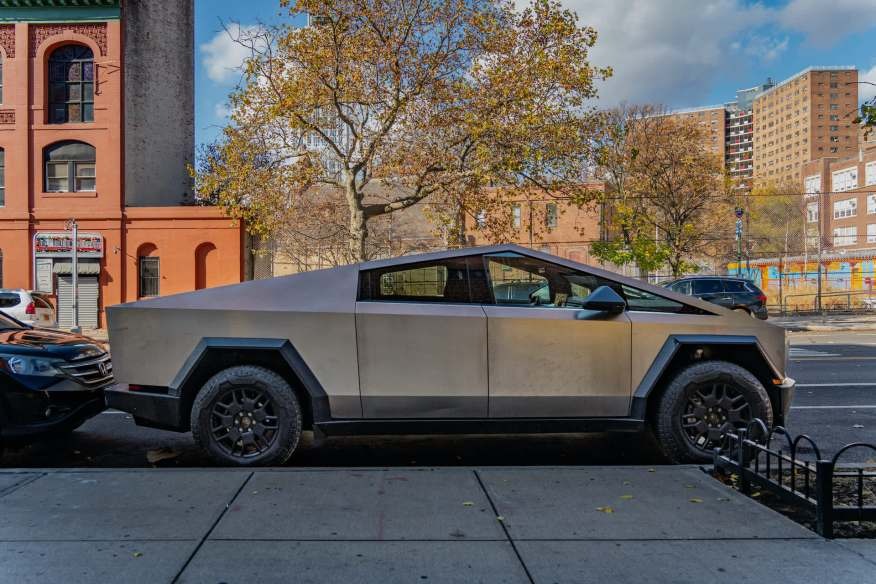
The Numbers Behind the Collapse
Tesla’s second-quarter delivery report revealed a mere 10,394 vehicles sold in its “other models” category, which includes the Model S, Model X, and Cybertruck, representing a catastrophic 52% drop from the same period last year 26. While Tesla doesn’t break out exact Cybertruck figures, registration data and production estimates indicate roughly 5,000 units were delivered in Q2 2025, down sharply from 7,100 in Q1. This puts the Cybertruck’s annual sales rate at just 20,000 units, a mere 8% of the 250,000 annual production target Musk boldly projected for 2025. Even Ford’s F-150 Lightning, despite its own 26% sales decline, outsold the Cybertruck with 5,842 deliveries last quarter.
Design Compromises and Quality Failures
The Cybertruck’s radical stainless-steel design, initially a headline-grabbing asset, has proven functionally problematic. Owners have reported panels detaching while driving due to adhesive failures, prompting Tesla to recall all 46,100 Cybertrucks produced to date to address what the NHTSA called a major accident risk. This recall compounds seven other safety issues, including a defective accelerator pedal linked to unintended acceleration and sharp door edges capable of injuring users. “The adhesive bonding the panels becomes brittle in cold conditions, essentially turning the truck into a rolling safety hazard,” noted automotive safety researcher Evelyn Torres. “For an $80,000–$100,000 vehicle, this is inexcusable”.
Economic and Political Headwinds
Beyond quality issues, the Cybertruck faces a perfect storm of economic and cultural challenges. Its $80,000–$100,000 price tag places it far beyond mainstream affordability, while the imminent phaseout of federal EV tax credits further erodes its value proposition. Simultaneously, Musk’s increasingly polarizing political alignment, including vocal support for Donald Trump and far-right European parties, has alienated environmentally conscious EV buyers. “Many left-leaning Tesla owners have dumped their vehicles entirely over Musk’s MAGA turn,” reported Headlight News, with sales plunging 75% in the Netherlands and 62% in the UK as global resentment solidified.
Depreciation Disaster
The Cybertruck’s rapid depreciation has shattered Musk’s claims that Teslas could appreciate as “appreciating assets.” Data from CarGurus reveals a 45% value loss within the first year of ownership, nearly double the industry average. Owners of the $100,000 AWD Foundation Series now report trade-in offers as low as $65,400, prompting Tesla to temporarily halt Cybertruck trade-ins entirely in May. “This polygonal nightmare is flailing,” declared Fast Company, noting that Tesla’s entire lineup now leads depreciation charts, with Model 3 and Y values dropping fastest among the top 200 models.

Production Overreach
Perhaps most damaging long-term is Tesla’s massive production miscalculation. The company tooled its Austin Gigafactory for 250,000 annual Cybertruck units but currently operates at less than 10% capacity, leaving assembly lines idle and workers reassigned. With over 10,000 unsold Cybertrucks accumulating in storage lots, representing $800 million in stagnant inventory, analysts question whether demand can ever justify the infrastructure. “Tesla built a cathedral to a product nobody wants,” remarked manufacturing consultant Arjun Patel. “They’re now sitting on three months of inventory with no credible path to clearance”.
A Symbol of Tesla’s Wider Crisis
The Cybertruck’s implosion mirrors Tesla’s broader challenges. The company’s global deliveries fell 13.5% year-over-year in Q2, while Chinese rival BYD, now the world’s top EV maker, er surged to 1 million BEV sales in the first half of 2025 alone. Tesla’s net income cratered 71% in Q1, and its stock remains down 17% this year despite investor optimism about robotaxi ventures.
What began as a futuristic statement now serves as a cautionary tale: revolutionary design cannot compensate for impracticality, poor execution, and alienated customers. As the Cybertruck’s stainless-steel panels gather dust on storage lots, its greatest legacy may be as a $3 billion monument to ambition outpacing reality.
Subscribe to my whatsapp channel

Comments are closed.