
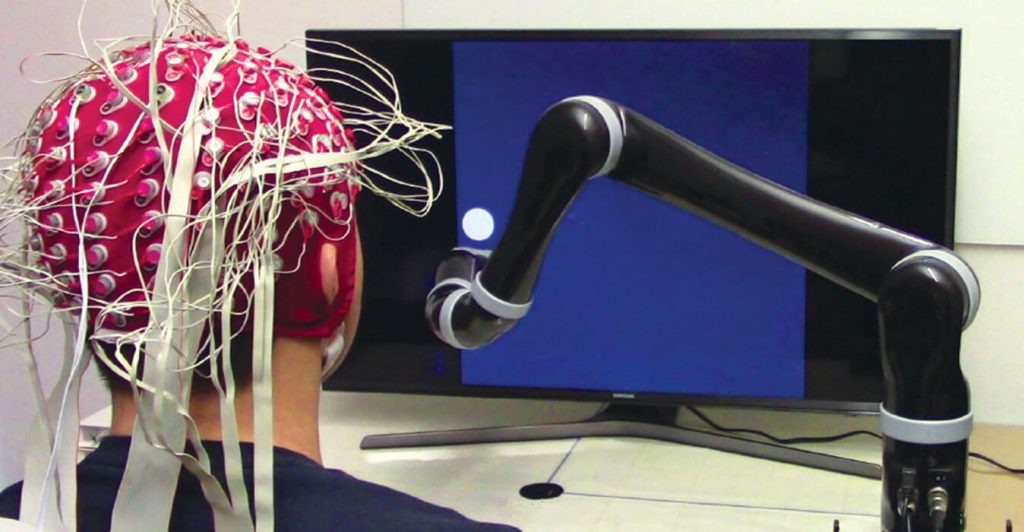

Carnegie Mellon University researchers have achieved a breakthrough in noninvasive brain-computer interfaces (BCIs), enabling precise robotic hand control through thought alone. By combining electroencephalography (EEG) sensors with deep learning algorithms, their system translates neural activity into real-time robotic commands without surgical implants. In peer-reviewed trials, participants successfully manipulated individual robotic fingers with over 80% accuracy for two-finger tasks and 60% for three-finger movements a previously unattainable milestone for scalp-based systems.
The Science Behind Thought-Driven Robotics
The technology leverages custom AI models like EEGNet, which decodes electrical patterns from the brain’s motor cortex when users imagine finger movements. Despite the cortex’s complex neural overlap, the system distinguishes subtle signal variations through patient-specific calibration. “The innovation in AI technology has enabled us to greatly improve performance versus conventional techniques,” explained Professor Bin He, who led the study published in PNAS Nexus. Key to this advancement is the neural network’s ability to filter noise from raw EEG data, converting intention into fluid motion within milliseconds.

This approach eliminates the risks associated with invasive BCIs (like Neuralink’s brain implants) while democratizing access. Clinicians can now deploy the system using portable EEG headsets and commercially available robotic hands.
Transforming Rehabilitation and Daily Living
For stroke survivors and spinal injury patients, this technology promises unprecedented autonomy. During trials, users performed tasks once deemed impossible without surgery, such as typing on keyboards and grasping small objects. Dylan Forenzo, a Ph.D. researcher on He’s team, emphasized its real-world value: “Even small improvements in hand function dramatically impact independence, whether holding a cup or signing a document”.
The noninvasive model also accelerates adoption in therapy settings. Hospitals can conduct sessions without neurosurgical teams, and patients can continue training at home using affordable hardware. Early studies note enhanced neuroplasticity in motor-impaired users who train with these systems, suggesting potential long-term recovery benefits.
Future Trajectory: From Labs to Living Rooms
While excitement grows, challenges persist. EEG’s sensitivity to environmental interference (e.g., muscle twitches or electrical noise) currently limits public use. However, Carnegie Mellon engineers are refining sensor arrays and AI architectures to bolster reliability. Next-phase trials will test the system’s ability to control advanced robotic limbs for complex tasks like utensil manipulation.
Industry analysts predict commercial applications within 3–5 years, coinciding with broader robotics integration. As noted in the Healthcare journal, assistive technologies like these are “revolutionizing patient outcomes” by merging AI mobility aids with user-centric design. Ethical frameworks for BCIs are also advancing, with the IEEE recently publishing privacy guidelines for neural data.
The Bigger Picture
This technology transcends medical use. Future iterations could enable factory workers to operate machinery hands-free or gamers to interact with virtual worlds intuitively. “We’re pushing noninvasive neuroengineering solutions that can help everybody,” He stated, underscoring the lab’s mission to make BCIs universally accessible. With 2.5 billion people globally needing assistive devices, Carnegie Mellon’s work signals a seismic shift in merging human intention with mechanical action, no scalpels required.
Subscribe to my whatsapp channel

Comments are closed.