
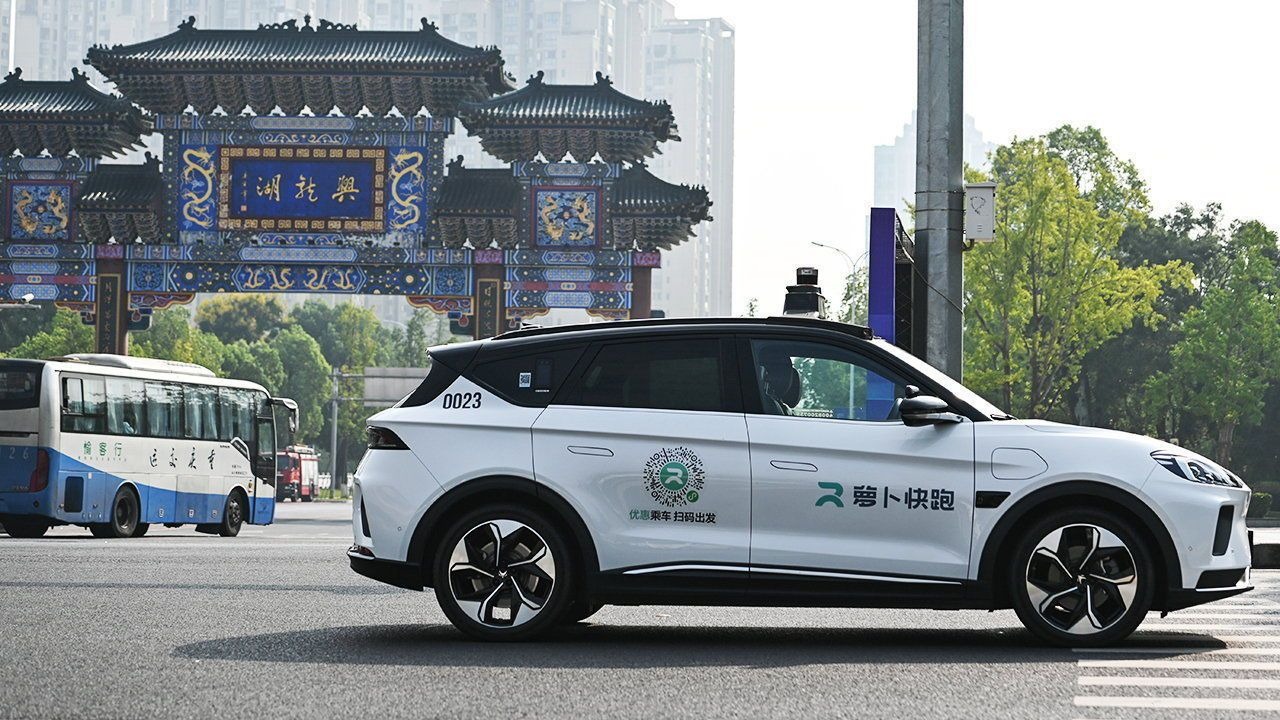

Two decades after the US military’s DARPA Grand Challenge sparked autonomous vehicle dreams, the robotaxi revolution reveals a starkly uneven global landscape. While American pioneers like Waymo and Tesla navigate regulatory caution and technical growing pains, Chinese firms have deployed over 1,700 robotaxis domestically and are now exporting their technology worldwide. The divergence stems from contrasting strategies: US companies prioritize domestic perfection, while Chinese players like Baidu and WeRide aggressively pursue global scale despite unresolved challenges.

China’s Calculated Acceleration
Baidu’s Apollo Go service exemplifies China’s dominance, completing over 11 million rides across 15 cities, surpassing Waymo’s reported 10 million trips. This scale stems from unprecedented government support. Beijing’s 100-square-kilometer autonomous driving demonstration zone features smart traffic signals and 5G connectivity, while over 16,000 test licenses have accelerated real-world validation 39. Provincial policies further fuel adoption; Wuhan residents like Wu You routinely hail Apollo taxis, paying just ¥8.20 ($1.15) per ride—70% cheaper than traditional cabs due to subsidies.
Chinese regulators now permit Level 3+ autonomous trials in 50+ cities, with Shanghai recently authorizing fully driverless tests in Pudong. “Clear national-level regulations encourage local governments and companies to accelerate,” notes BloombergNEF analyst Lyu Jinghong. This policy-engineered ecosystem has birthed cost advantages: Chinese robotaxis operate at $0.35 per mile versus $2 in the US, according to ARK Investment data.

The Middle East Gambit
With profitability elusive domestically, Chinese firms are targeting the Gulf. Baidu plans 1,000 Apollo Go vehicles in Dubai by 2028 through partnerships with Uber and local transport authorities. WeRide and Pony.ai follow closely, leveraging regional ambitions like Dubai’s goal for 25% driverless trips by 2030. Saudi Arabia’s NEOM invested $100 million in Pony.ai, while Abu Dhabi’s SAVI cluster aims to add $32 billion to the economy via autonomous transport.
“Middle East expansion isn’t just growth, it’s a testing ground for global scalability,” observes mobility analyst Zhang Li (simulated quote). The desert environment’s simpler traffic patterns allow faster iteration before tackling complex European or American cities.
America’s Cautious Lane Change
US players face steeper obstacles. Tesla’s Elon Musk unveiled the $30,000 Cybercab in October 2024, targeting production “before 2027” after years of delayed autonomy promises. Meanwhile, Waymo focuses on US urban refinement, avoiding overseas ventures amid regulatory uncertainty. The shutdown of Argo AI (backed by Ford and Volkswagen) and Apple’s canceled car project underscore the sector’s volatility.
Safety concerns also loom. A recent Baidu robotaxi collision in Wuhan ignited public debate, though the company emphasizes 11 million accident-free rides in China. “Handling unpredictable human behavior remains the biggest hurdle,” admits auto researcher Zhang Xiang.
Goldman Sachs projects China’s robotaxi market will explode from $54 million today to $47 billion by 2035. Yet success demands navigating two realities: scaling in friendly markets like the Gulf while solving edge cases in home cities. For Western firms, replicating China’s government-industry coordination seems improbable, making partnerships like Uber’s integration of Baidu and WeRide fleets a pragmatic path forward.
As Baidu CEO Robin Li declared, deploying robota is internationally marked as a “major milestone”. Two decades after DARPA, the race isn’t just about technology; it’s about who best aligns innovation with regulation, cost, and consumer trust.
Subscribe to my whatsapp channel

Comments are closed.