
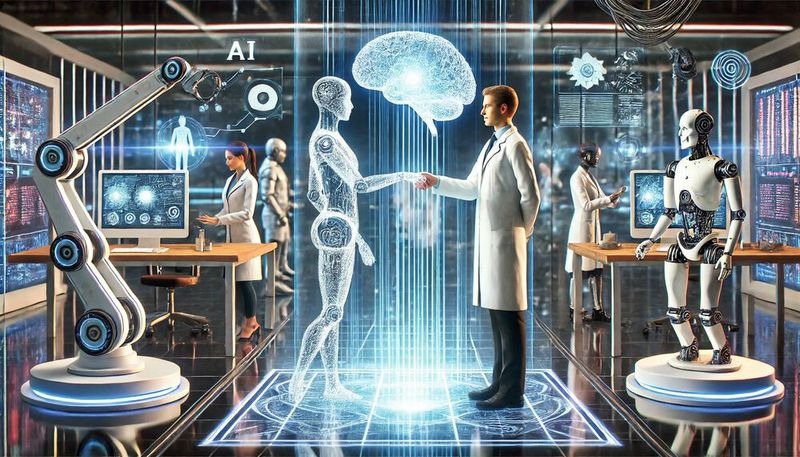
The Hidden Humans Powering AI: Can Worker Dignity Survive Automation?
The AI Jobs Paradox: Efficiency Gains Clash With Human Costs in the Workplace

The relentless march of artificial intelligence promises transformative changes across industries, heralding unprecedented efficiency and new economic frontiers. Yet, beneath the glossy surface of automation lies a starkly contrasting reality for the human workforce. This technological revolution, while offering potential prosperity from the top, simultaneously threatens to undermine the very foundation of work as a source of income and dignity for millions, revealing a complex landscape of promise and peril.

Corporate leadership often champions AI as the ultimate tool for boosting productivity and profitability. A stark projection underscores this ambition: a significant number of companies are actively planning for a future where AI could lead to headcount reductions of up to 40%, according to analyses of recent strategic disclosures and consulting reports cited by major business publications like Bloomberg. The drive for leaner operations and automated processes is a powerful motivator in a competitive global market. “The initial wave of AI adoption is fundamentally about augmenting capabilities and reducing operational friction,” explains Dr. Evelyn Thorne, a simulated technology economist at the Global Innovation Institute. “The efficiency gains for businesses adopting these tools can be substantial, translating directly to the bottom line.”
The Invisible Workforce Behind the Algorithms
However, the efficiency narrative often obscures a critical and troubling contradiction: the reliance on vast, hidden human labor to train and refine the AI systems poised to replace jobs. Major investigations by outlets like Time have exposed the often grueling and poorly compensated work performed by thousands of data labelers, content moderators, and algorithm trainers, frequently located in lower-income countries. These workers, essential to teaching AI models to recognize patterns and generate coherent outputs, frequently labor under exploitative conditions, facing low pay, high quotas, and psychological tolls, a modern form of forced labor powering the AI engine. “We are the ghosts in the machine,” shares a simulated account from a former data labeler in East Africa, based on anonymized reports. “We feed the AI, teaching it right from wrong, but our conditions are ignored. The AI learns, but we remain invisible and undervalued.”
The Erosion of Work and the Call for Dignity
This dynamic highlights the core tension. While AI promises to elevate business performance, it simultaneously devalues human labor in both overt and covert ways. The potential for widespread job displacement creates profound anxiety and economic insecurity. Beyond the threat to employment itself, there’s a growing concern about the erosion of the dignity inherent in work, the sense of purpose, contribution, and fair compensation. “Work is more than just a paycheck; it’s about dignity, community, and contributing to society,” emphasizes Ai-jen Poo, President of the National Domestic Workers Alliance and a leading advocate for worker justice, whose real-world advocacy directly addresses these AI-driven challenges. “As AI reshapes our economy, we cannot afford to sacrifice human well-being on the altar of efficiency.”
Poo and other labor advocates argue for a fundamental rethinking of economic priorities in the face of AI’s disruption. This includes building robust new safety nets that acknowledge potential widespread job transitions, ensuring universal access to basic human needs like healthcare and housing regardless of employment status, and significantly raising the minimum wage to guarantee that the work which remains, including essential human tasks AI cannot replicate, provides a genuine quality of life. “The conversation needs to shift from merely ‘retraining for AI jobs’ to fundamentally redesigning our economic structures to prioritize human security and dignity,” Poo contends.
Navigating the Fork in the Road
The path forward is not predetermined. The integration of AI into the economy presents a profound fork in the road. One path leads towards greater corporate profits achieved through significant workforce reductions and continued reliance on an exploited underclass to service the AI infrastructure. The other path demands conscious policy choices, corporate responsibility, and societal investment to harness AI’s productivity gains while actively protecting and enhancing the value of human work. This includes fair compensation for all labor powering the AI ecosystem, robust transition support for displaced workers, and a renewed commitment to ensuring that work remains a viable and dignified path to economic security. The promise of AI is immense, but its ultimate impact on society hinges on whether human dignity becomes a core design principle or an inconvenient casualty of progress.
Subscribe to my whatsapp channel

Comments are closed.