
America’s Skies Open for Business as Drone Delivery Finally Prepares for Takeoff
Beyond the Horizon: The Real Start of America’s Drone Delivery Era

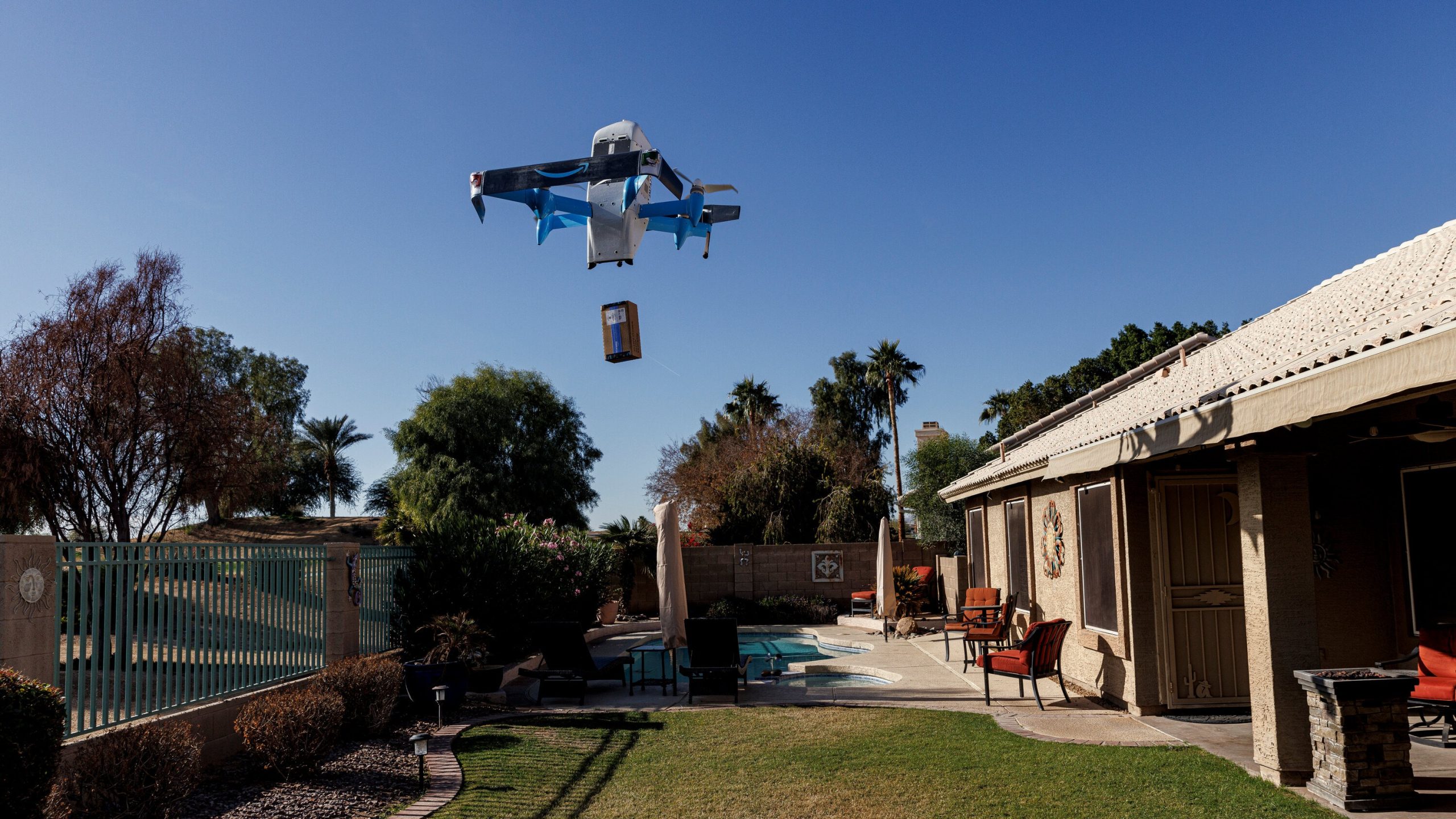
The faint whir of propellers cuts through a suburban Texas afternoon as a Walmart drone descends precisely onto Janet Toth’s driveway. Within moments, her 9-year-old daughter Julep retrieves a perfectly chilled pint of ice cream delivered faster than it would take most families to drive to the store. “I wave at the drone, say ‘Thank you,’ and get the food,” Julep tells Newsweek. “It’s part of everyday life now”.
This scene, once pure science fiction, is accelerating toward reality across American neighborhoods. After years of regulatory delays and technical hurdles, drone delivery is poised for explosive growth. The catalyst? A landmark proposed rule from the U.S. Transportation Department announced August 5, 2025, aims to eliminate the single biggest barrier to scale: the requirement for operators to maintain a visual line of sight (VLOS) with drones during flight. Transportation Secretary Sean Duffy declared this move would “unleash American drone dominance,” fundamentally altering how goods move through U.S. airspace.
Regulatory Revolution Unlocks the Skies
For over a decade, commercial drone operations languished under restrictive rules requiring individual waivers for beyond visual line of sight (BVLOS) flights. Companies like Amazon, Walmart, and Alphabet’s Wing navigated a slow, case-by-case approval process. Amazon spent years rigorously testing onboard detect-and-avoid technology, conducting real-world flight demonstrations dodging planes, helicopters, and even hot air balloons before securing FAA BVLOS approval in May 2024.
The newly proposed FAA rule, now open for 60 days of public comment, replaces this patchwork with standardized requirements. Drones under 1,320 pounds can fly below 400 feet without VLOS waivers if equipped with collision-avoidance systems, while operators undergo fingerprint-based criminal checks. Yariv Bash, CEO of drone firm Flytrex, hailed it as a “foundational milestone” enabling drones to “scale across more communities”.
Retail Giants Race Toward the Horizon
With regulatory winds shifting, major retailers are aggressively expanding:
-
Walmart and Wing now deliver from 18 Dallas stores and just announced a massive expansion to 100 stores across Atlanta, Charlotte, Houston, Orlando, and Tampa by summer 2026. “This is real drone delivery at scale,” declared Wing CEO Adam Woodworth.
-
Amazon leveraged its 2024 FAA approval to widen drone delivery zones in College Station, Texas, and launch in Tolleson, Arizona. It plans new operations in Dallas, San Antonio, and Kansas City using its quieter, more advanced MK-30 drones (capable of carrying 5-pound payloads at 73 mph).
-
Zipline, partnering with Walmart since 2021, operates heavier drones hauling 4-pound packages up to 120 miles round-trip, proving vital for rural medical delivery.
“Industry players were stuck in ‘treading water mode’ awaiting regulatory clarity,” explains aviation analyst Rebecca Shaw. “Now we’ve hit planetary alignment: customer demand, technical readiness, and regulatory support converging”.
The $13.50 Problem: Scaling Beyond Novelty
Despite momentum, drone delivery faces a stark economic challenge. Consulting firm McKinsey estimates the current cost per drone delivery at $13.50 compared to just $1.90 for a delivery van carrying 100 packages. Labor remains the primary bottleneck, as FAA rules previously required one employee per drone.
“It’s all a question of how many people you have involved,” emphasizes McKinsey partner Robin Riedel. If operators can monitor 20 drones simultaneously, costs could plummet to $1.80 per delivery, suddenly competitive with ground transport. The new BVLOS rule directly enables this efficiency, allowing a single pilot to oversee entire fleets remotely.
Beyond cost, public skepticism lingers. Noise complaints in CollegeStationon one resident likened early drones to a “giant nagging mosquito which o” pushed Amazon to develop quieter models. Privacy advocates also question cameras used for navigation. Amazon insists its systems only record overhead footage during deliveries for safety.
The Future: Not Replacing Drivers, Redefining Speed
Contrary to fears, drone delivery isn’t poised to displace human drivers entirely. As DoorDash’s drone lead Harrison Shih notes, existing technology can’t handle bulky orders like 40-pound dog food bags. DoorDash observed increased demand for traditional deliveries alongside drone options in test markets.
Amazon’s long-term ambition remains staggering: 500 million annual drone deliveries by 2030. While still a fraction of its total volume, this would cement drones as a niche for high-speed, low-weight essentials medications, groceries, or that forgotten phone charger.
“Safety and public trust are non-negotiable,” says Shaw. “But with FAA framework solidifying, we’re finally moving from pilot projects to pervasive service. Your neighborhood may soon have more drones than mail trucks”.
As for Janet and Julep Toth? They’ll keep waving to the skies. “I saw drones deliver in Korea years ago,” Janet remarks. “I wondered when America would catch up”.
Subscribe to my whatsapp channel

Comments are closed.