

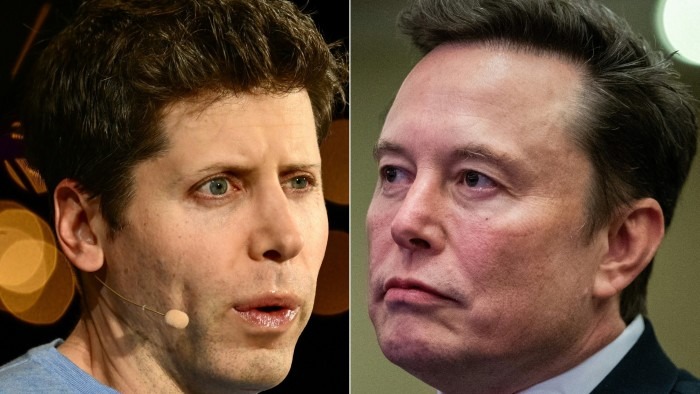
OpenAI CEO Sam Altman has bluntly dismissed Elon Musk’s warnings that OpenAI could dominate or “eat Microsoft alive” following the integration of the new GPT-5 AI model across Microsoft’s product suite. When questioned about Musk’s critique during a CNBC interview, Altman stated, “You know, I don’t think about him that much,” and questioned the consistency of Musk’s stance given his history of attacking OpenAI’s technology and strategy.
The exchange came hours after Microsoft CEO Satya Nadella announced GPT-5’s full deployment into core Microsoft products, including Microsoft 365 Copilot, GitHub Copilot, Azure AI Foundry, and the standalone Copilot app. Nadella hailed GPT-5 as OpenAI’s “most capable model yet,” emphasizing breakthroughs in reasoning, coding, and natural conversation powered by Azure’s infrastructure. Musk responded to Nadella’s post on X, warning, “OpenAI is going to eat Microsoft alive,” a remark Nadella deflected by noting competition has driven tech innovation for decades, adding, “Each day you learn something new and innovate, partner, and compete”.
The Clash of Visions
Altman’s dismissal underscores a years-long feud with Musk, who co-founded OpenAI with him in 2015 as a nonprofit research lab. Musk resigned from OpenAI’s board in 2018 over strategic disagreements, particularly opposing its shift toward commercialization and partnership with Microsoft. He later launched rival AI firm xAI, home to the Grok chatbot, and has since repeatedly criticized OpenAI’s models as inferior and its mission as compromised. Earlier this year, Musk attempted to acquire OpenAI’s parent nonprofit for $97.4 billion, an offer Altman rejected with a sarcastic counterproposal to “buy Twitter for $9.74 billion”.
Industry analysts suggest Musk’s “eat Microsoft alive” jab aims to destabilize the partnership by implying OpenAI’s growing autonomy could leave Microsoft dependent on a competitor. “Musk is highlighting a genuine tension,” said Dr. Lena Chen, a Stanford AI governance researcher. “Microsoft relies on OpenAI for cutting-edge AI, but as OpenAI’s valuation soars and it negotiates reduced revenue shares, the power balance is shifting”.
GPT-5: A “PhD-Level” Leap
Meanwhile, Altman has framed GPT-5 as a historic step toward artificial general intelligence (AGI), calling it OpenAI’s first model capable of “PhD-level expertise” across complex domains. In testing, it solved a challenging email problem that stumped Altman himself, making him feel “useless” and “scared” by its capability. He likened its societal impact to the Manhattan Project, though clarified its effects would be constructive, not destructive. The model introduces “vibe coding,” enabling app creation from minimal prompts, and excels at agentic tasks requiring minimal human oversight.
Microsoft’s swift integration signals its $13 billion bet on OpenAI remains central to its AI strategy. Developers using Microsoft’s tools now access GPT-5’s reasoning engine for coding and enterprise applications, with higher usage limits than OpenAI’s consumer-tier ChatGPT.
The Rivalry’s Broader Impact
The Altman-Musk rivalry now mirrors a broader industry clash between tech giants and their AI protégés. As Amazon, Google, and xAI race to deploy ever-larger models, regulators increasingly scrutinize these alliances for antitrust risks. “When partners become competitors, customers face uncertainty,” noted tech historian Robert Greene. “Musk’s taunts amplify valid questions about Microsoft’s long-term control, but Altman’s indifference shows OpenAI is confident in its path”.
For now, Microsoft and OpenAI appear tightly aligned. But as Musk’s Grok 5 looms and Altman prioritizes “autonomous AI agents,” their collaboration faces pressures no AI model can yet resolve.
Subscribe to my whatsapp channel

Comments are closed.