
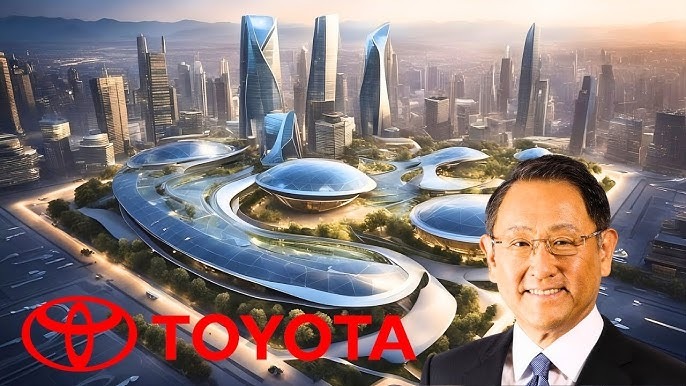

In early 2020, Toyota CEO Akio Toyoda stood on a CES stage and announced something unusual – not a car, but a city.
Woven City, he said, would be a living laboratory at the foot of Mount Fuji. Researchers, engineers, and technologists (the “Weavers”) would co-design the future of mobility. Zero accidents. Vehicle-to-everything communication. A city that learns.
It sounded bold. It also sounded distant.
Then, six months ago, the first residents moved in.
When safety means being watched
Here’s what those first Weavers noticed almost immediately: cameras. Not just traffic cams. Pervasive, multi-angle surveillance covering streets, intersections, and public spaces.
Toyota’s logic is straightforward. To achieve zero accidents, you need real-time awareness of every moving object – cars, scooters, pedestrians, bikes. That requires sensors. Lots of them.
But there’s a tension that no press release fully addresses.
Smart city history is littered with similar promises. Toronto’s Sidewalk Labs project collapsed partly over data governance concerns. South Korea’s Songdo, built from scratch as a “ubiquitous city,” struggled with low resident satisfaction despite its advanced infrastructure. The pattern is consistent: people want safety, but they don’t want to feel watched in their own neighborhood.
Woven City is smaller than those projects, which makes the surveillance feel even more concentrated.
A dashboard for your privacy – nice idea, but…
Toyota anticipated the unease. Their answer is the “Data Fabric” – a system that lets residents manage data-sharing preferences. Think of it as a granular privacy settings page, but for an entire urban environment.
On the surface, that’s thoughtful.
But here’s where things get real. Woven City’s entire purpose is to generate data. Workshops, prototype testing, vehicle-to-everything communication – none of that works without information flowing. If residents dial their privacy settings to “minimum,” does the lab still function? And if they don’t, is that truly a choice?
This isn’t a hypothetical. Similar systems in other smart neighborhoods have shown that people say they value privacy but rarely change default settings. The “Data Fabric” could become a fig leaf – technically empowering, psychologically inert.
The scale problem nobody mentions
There’s another quiet tension. Woven City is deliberately small. That limits real-world testing of mobility prototypes. You can’t simulate a city’s chaos with a few hundred residents and controlled streets.
So what is Woven City actually for?
The honest answer: a proof of concept. A showcase. A very expensive, very public experiment in how much surveillance people will tolerate when safety is the stated goal.
Toyota is shifting from automaker to “mobility company.” That’s the industry signal. But mobility companies don’t just sell rides – they sell data, routes, behavior insights. Woven City is a dry run for that business model.
And financial sustainability remains an open question. Who pays for the cameras, the Data Fabric, the ongoing maintenance? Toyota, for now. But long-term? That’s where the conversation gets uncomfortable.
The thing Woven City is really testing
Here’s the part that stays with me.
Woven City isn’t primarily testing autonomous shuttles or V2X communication. Those technologies already exist in less ambitious forms.
What it’s really testing is trust.
How much transparency is enough? How much control over data actually satisfies people? And when residents realize that “zero accidents” requires near-total observation, do they stay – or quietly leave?
The first six months haven’t answered those questions. But the cameras are already up. The data is already flowing.
And somewhere at the foot of Mount Fuji, a Weaver is probably looking out their window, wondering if a city that never crashes is worth a city that never stops watching.
That’s the conversation Toyota didn’t start at CES. But it’s the one that will define Woven City’s future – and maybe the future of every “smart” neighborhood to come.
Subscribe to my whatsapp channel
